


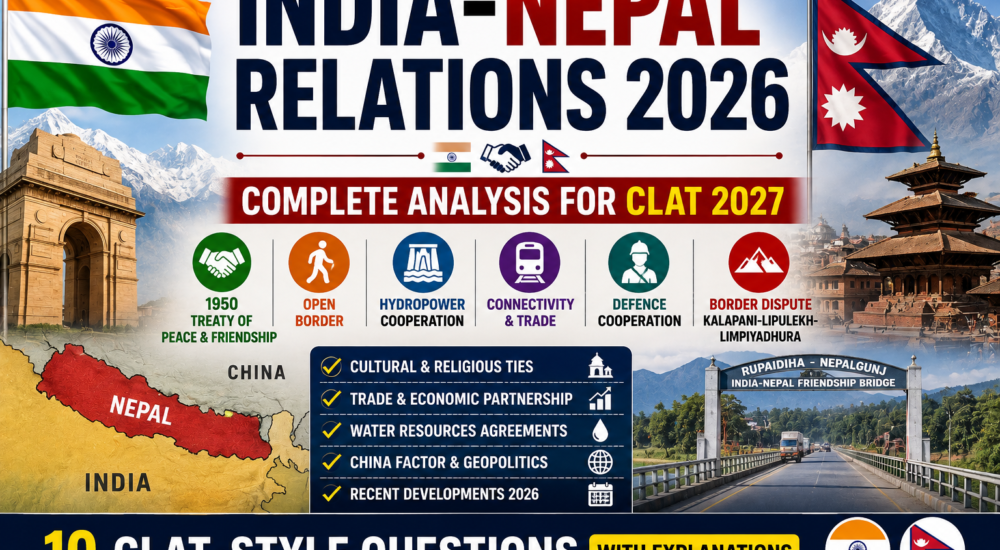
India–Nepal Relations 2026: Complete Analysis for CLAT 2027
India–Nepal relations are among India’s most unique and complex bilateral relationships. The relationship is built on geography, history, religion, culture, trade, open borders and extensive people-to-people contacts.
Unlike many other international relationships, India and Nepal share an open border, allowing citizens of both countries to move across the border without the conventional passport-and-visa regime.
At the same time, the relationship has faced challenges involving border disputes, the 1950 Treaty of Peace and Friendship, political changes in Nepal, water resources, trade dependence and Nepal’s growing engagement with China.
For CLAT 2027, India–Nepal relations is a particularly important topic because it combines:
International Relations + Geography + Economy + Security + Environment + Constitution + Current Affairs
This article provides a comprehensive analysis of the topic.
Why Are India–Nepal Relations Important for CLAT?
India and Nepal share a relationship that goes beyond conventional diplomacy.
The relationship involves:
- An open international border
- Deep cultural and religious links
- Economic interdependence
- Hydropower cooperation
- Defence cooperation
- Cross-border infrastructure
- Tourism and pilgrimage
- Migration and employment
- Regional security
- India-China strategic competition
India officially describes Nepal as a priority partner under its Neighbourhood First Policy.
Therefore, CLAT aspirants should study India–Nepal relations as a multi-dimensional international relations topic rather than simply memorising a few facts.
Nepal: Basic Facts
| Particular | Information |
| Country | Nepal |
| Capital | Kathmandu |
| Currency | Nepalese Rupee |
| Region | South Asia |
| Political System | Federal Democratic Republic |
| Current President | Ram Chandra Paudel |
| Current Prime Minister | Balendra Shah |
| Official Language | Nepali |
| Highest Mountain | Mount Everest |
| Border with India | Five Indian States |
| Border with China | Tibet Autonomous Region |
Nepal is a landlocked country located between India and China.
It shares its southern, eastern and western borders with India and its northern border with China.
Nepal’s strategic location makes it important for India’s security as well as for China’s growing presence in South Asia.
Nepal’s current President is Ram Chandra Paudel, while Balendra Shah became Prime Minister on 27 March 2026.
CLAT Quick Fact
Nepal = India + China + Himalayas + Open Border
India and Nepal Share a Unique Relationship
India and Nepal have extensive civilisational, cultural and social connections.
The relationship is often described through the expression:
“Roti-Beti Ka Rishta”
This expression refers broadly to the close social, familial and cultural connections across the border.
India’s Ministry of External Affairs describes India–Nepal ties as a special and unique relationship rooted in shared heritage, civilisation, culture and extensive people-to-people relations.
Historical and Cultural Connections
The relationship between India and Nepal goes back centuries.
Important cultural and religious connections include:
Ayodhya – Janakpur
Janakpur in Nepal is traditionally associated with Goddess Sita, while Ayodhya in India is associated with Lord Rama.
This creates a major religious and cultural link between the two countries.
Lumbini – Bodh Gaya
Lumbini, in Nepal, is traditionally recognised as the birthplace of Gautama Buddha.
Bodh Gaya, in India, is associated with Buddha’s enlightenment.
Pashupatinath – Kashi
The Pashupatinath Temple in Kathmandu and Kashi Vishwanath in Varanasi represent another important religious connection.
These links have also been used to promote cross-border religious tourism.
India has promoted the Ramayana Circuit, including connectivity between important sites associated with Lord Rama and Goddess Sita.
India–Nepal Diplomatic Relations
India and Nepal formally established diplomatic relations in the modern era in 1947.
The relationship was later institutionalised through the:
Treaty of Peace and Friendship, 1950
The treaty remains one of the most important documents for understanding bilateral relations.
Treaty of Peace and Friendship, 1950
The:
India–Nepal Treaty of Peace and Friendship
was signed on:
31 July 1950
The treaty established a framework for peace, friendship and close relations between the two countries.
The treaty recognises:
- Sovereignty
- Territorial integrity
- Independence
- Peaceful relations
- Diplomatic relations
- Security consultations
- Economic cooperation
Article 1 recognises the sovereignty, territorial integrity and independence of both countries.
Why Is the 1950 Treaty Controversial?
The treaty has remained politically sensitive in Nepal.
Some sections of Nepal’s political class have argued that the treaty is:
- Outdated
- Unequal
- Inconsistent with Nepal’s contemporary sovereign status
Nepal has periodically sought its review, revision or replacement.
India has also acknowledged discussions around updating aspects of the relationship.
CLAT Point
Do not assume that the treaty has been cancelled.
The important point is:
The 1950 Treaty remains an important framework of India–Nepal relations, while Nepal has sought its review/update.
Open Border Between India and Nepal
One of the most distinctive characteristics of India–Nepal relations is the:
Open Border
Indian and Nepali citizens can generally cross the border without the conventional passport-and-visa requirements applicable to most international borders.
The open border facilitates:
- Employment
- Trade
- Tourism
- Education
- Family relationships
- Religious pilgrimage
- Cultural exchange
However, the open border also creates security challenges.
These include:
- Smuggling
- Human trafficking
- Drug trafficking
- Fake currency
- Cross-border crime
- Illegal movement of goods
Therefore, India and Nepal regularly cooperate on border management and security.
India–Nepal Border Geography
Nepal shares a border with five Indian states:
- Uttarakhand
- Uttar Pradesh
- Bihar
- West Bengal
- Sikkim
Easy Memory Trick
S-U-B-W-S
Or remember the geographical order broadly from west to east:
Uttarakhand → Uttar Pradesh → Bihar → West Bengal → Sikkim
CLAT Question Possibility
A question may ask:
Which of the following Indian states does NOT share a border with Nepal?
Possible options could include:
- Uttar Pradesh
- Bihar
- Assam
- Sikkim
Correct answer:
Assam
India–Nepal Trade Relations
India is Nepal’s largest trading partner.
According to the Government of India’s 2026 information, India accounts for more than 60% of Nepal’s total trade volume.
This demonstrates the significant economic interdependence between the two countries.
India provides Nepal access to:
- Indian markets
- Indian ports
- Transit routes
- Rail connectivity
- Road connectivity
- Energy markets
Nepal exports goods such as:
- Electricity
- Agricultural products
- Textiles
- Cardamom
- Tea
- Other manufactured and agricultural goods
Why Is India Economically Important for Nepal?
Nepal is landlocked.
Therefore, access to international markets requires efficient transit routes through neighbouring countries.
India provides Nepal with access to major ports including:
- Kolkata Port
- Visakhapatnam Port
This gives Nepal access to international trade routes.
The relationship is therefore not simply based on proximity.
It is also based on:
Geography → Transit → Trade → Economic Interdependence
Cross-Border Railway Connectivity
Rail connectivity has become an important component of India–Nepal relations.
Important projects include:
Jaynagar–Kurtha Railway
This connects Bihar in India with Nepal.
Jogbani–Biratnagar Railway
This supports connectivity between northeastern Bihar and Nepal.
In November 2025, India and Nepal amended the Treaty of Transit through a Letter of Exchange, expanding rail-based freight routes and allowing broader movement of containerised and bulk cargo.
Major 2026 Connectivity Development
A major development occurred in July 2026.
India operated its:
First Direct Commercial Container Freight Train to Nepal
The 40-wagon train travelled from:
Kolkata Port → Biratnagar Customs Yard
The service operates under the revised India–Nepal Rail Transit Protocol.
The major significance is that containerised cargo can move directly without transshipment at the border.
This can reduce:
- Transportation time
- Logistics costs
- Cargo handling
- Trade barriers
CLAT Current Affairs Fact
July 2026 → First direct commercial container freight train → Kolkata to Biratnagar
Barabanki–Bahraich Highway and Nepal Connectivity
Another important development for India’s northern connectivity is the proposed development of the:
Barabanki–Bahraich section of NH-927
The project will improve connectivity towards the:
Rupaidiha Land Port
which connects with Nepalgunj in Nepal.
This is particularly relevant for Uttar Pradesh and cross-border trade.
The Government has described the route as an important trade and connectivity link between India and Nepal.
CLAT Connection
Uttar Pradesh → Rupaidiha → Nepalgunj → India–Nepal trade
Hydropower: The Most Important Economic Opportunity
Nepal has enormous hydropower potential because of its Himalayan rivers and terrain.
India, meanwhile, has a huge and growing demand for electricity.
This creates a natural economic partnership.
Nepal
Has:
Hydropower potential
India
Has:
Large electricity market + investment + transmission infrastructure
Therefore:
Nepal produces electricity → India purchases electricity → Nepal earns revenue → India gets clean energy
Long-Term Power Trade Agreement
One of the most important developments in India–Nepal relations is the:
Long-Term Power Trade Agreement
India and Nepal agreed on a target of importing up to:
10,000 MW
of electricity from Nepal over a period of 10 years.
The agreement was finalised in January 2024.
This is strategically important because it can:
- Increase Nepal’s export earnings
- Encourage hydropower investment
- Provide India with clean electricity
- Improve regional energy integration
- Strengthen economic interdependence
Cross-Border Transmission Lines
Electricity trade requires transmission infrastructure.
India and Nepal have therefore been developing cross-border transmission links.
In 2025, agreements were signed for major transmission systems including:
- Inaruwa–New Purnea
- Lamki/Dododhara–Bareilly
These projects aim to increase electricity exchange and strengthen regional energy security.
Why Is Hydropower Strategically Important?
Hydropower cooperation is not only an economic issue.
It is also connected to:
Energy Security
India can diversify its electricity sources.
Climate Goals
Hydropower is a low-carbon source of electricity.
Nepal’s Economy
Electricity exports can generate foreign exchange.
Regional Integration
Cross-border grids create greater regional energy connectivity.
Therefore:
Hydropower = Economy + Energy Security + Climate + Regional Integration
Water Resources and River Cooperation
India and Nepal share several major rivers.
Important rivers include:
- Kosi
- Gandak
- Mahakali
- Karnali
Water cooperation has historically focused on:
- Flood control
- Irrigation
- Hydropower
- River management
- Water resource development
Kosi Agreement
The Kosi Agreement
was signed in:
1954
It concerns the development and management of the Kosi River, including flood control and irrigation-related infrastructure.
The agreement was subsequently revised.
The Kosi is particularly important because flooding in the river basin can affect large areas of Bihar.
Gandak Agreement
The:
Gandak Agreement
was signed in:
1959
It concerns irrigation and power development associated with the Gandak River.
The project has significance for agricultural development in both countries.
Mahakali Treaty
The:
Mahakali Treaty
was signed in:
1996
It concerns the integrated development of the Mahakali River, including:
- Sarada Barrage
- Tanakpur Barrage
- Pancheshwar Project
The treaty recognises the Mahakali as a boundary river over significant stretches.
CLAT Quick Revision
Kosi → 1954
Gandak → 1959
Mahakali → 1996
Pancheshwar Multipurpose Project
The:
Pancheshwar Multipurpose Project
is associated with the Mahakali River.
Its objectives include:
- Hydropower generation
- Irrigation
- Water management
The project has been discussed for decades but has faced delays relating to technical, financial and political issues.
Defence Cooperation
India and Nepal have extremely close military ties.
One unique tradition is the practice of granting the:
Honorary Rank of General
to the Army Chief of the other country.
This symbolises the close relationship between the Indian Army and Nepali Army.
In August 2026, Nepal’s President Ram Chandra Paudel conferred the honorary rank of General of the Nepali Army on India’s Chief of Army Staff, General Dhiraj Seth.
Gorkha Soldiers
Nepali citizens have historically served in the:
Indian Gorkha Regiments
of the Indian Army.
This has become one of the most important human and military links between India and Nepal.
The relationship involves:
- Recruitment
- Military training
- Pension and welfare
- Veteran relations
- Defence cooperation
Recent 2026 Defence Cooperation
Indian Army Chief General Dhiraj Seth visited Nepal from:
17–19 August 2026
The visit focused on strengthening:
- Defence cooperation
- Military-to-military relations
- Strategic communication
- Mutual understanding
The visit also included the traditional conferment of the honorary rank.
Border Security Cooperation
India and Nepal maintain institutional mechanisms for managing the open border.
One of the important mechanisms is the:
India–Nepal Joint Working Group on Border Management
The group discusses:
- Border infrastructure
- Boundary pillars
- Encroachments
- Cross-border crime
- Integrated Check Posts
- Roads
- Railway networks
- Institutional coordination
The 14th meeting of the Joint Working Group was held in Dehradun on 20–21 August 2026.
CLAT Current Affairs Fact
20–21 August 2026 → 14th India–Nepal JWG → Dehradun
India–Nepal Border Dispute
Despite close relations, India and Nepal have unresolved boundary issues.
The most prominent areas include:
- Kalapani
- Lipulekh
- Limpiyadhura
These areas are located near the India-Nepal-China tri-junction region.
Kalapani–Lipulekh–Limpiyadhura Issue
Nepal claims that the territory around:
Kalapani + Lipulekh + Limpiyadhura
belongs to Nepal.
India disputes Nepal’s claims and maintains its position regarding the boundary.
The dispute is historically connected with differing interpretations of the 1816 Treaty of Sugauli and the origin of the Mahakali/Kali River.
Why Is Lipulekh Strategically Important?
Lipulekh is important because of its location near:
- India
- Nepal
- China
It also has significance for the Kailash Mansarovar pilgrimage route.
Therefore, the issue has:
Territorial + Strategic + Religious + Geopolitical dimensions
The China Factor
China is an increasingly important factor in India–Nepal relations.
Nepal is located between:
India
and
China
China has expanded its engagement with Nepal through:
- Infrastructure
- Investment
- Connectivity
- Trade
- Tourism
- Development projects
The Trans-Himalayan connectivity agenda has become an important part of Nepal-China relations.
Why Does China Matter to India–Nepal Relations?
From India’s perspective, Nepal’s location has major strategic importance.
India is concerned about:
- Chinese strategic influence
- Infrastructure near the Himalayan region
- Cross-border connectivity
- Security implications
- External military or intelligence activities
However, Nepal has repeatedly emphasised its desire to maintain an independent foreign policy and balanced relations with both India and China.
CLAT Concept
Nepal’s strategic position can be understood through:
Geopolitical balancing
Nepal’s Foreign Policy: Balancing India and China
Nepal’s geography makes it difficult to ignore either neighbour.
Therefore, Nepal seeks economic and strategic engagement with:
India + China
For Nepal:
- India provides access to South Asian markets and ports.
- China provides northern connectivity and an alternative economic partner.
For India:
- A stable and friendly Nepal is important for Himalayan security and regional connectivity.
India’s Neighbourhood First Policy
India’s:
Neighbourhood First Policy
places importance on maintaining strong relationships with neighbouring countries.
Nepal is one of the key partners under this policy.
The objective is broadly to promote:
- Connectivity
- Trade
- Development
- Security cooperation
- People-to-people relations
- Regional stability
Development Partnership
India is involved in numerous development projects in Nepal.
Cooperation includes:
- Roads
- Schools
- Hospitals
- Health infrastructure
- Electricity
- Drinking water
- Community projects
- Reconstruction
- Heritage restoration
India has also supported High Impact Community Development Projects (HICDPs) in Nepal.
Digital Connectivity
Digital connectivity is becoming an increasingly important part of bilateral relations.
Cross-border digital payment mechanisms can facilitate:
- Tourism
- Retail transactions
- Medical travel
- Student movement
- Pilgrimage
India and Nepal have also worked to strengthen digital financial connectivity.
Religious Tourism
Religious tourism is a major component of India–Nepal relations.
Important destinations include:
Nepal
- Pashupatinath
- Janakpur
- Lumbini
- Muktinath
India
- Ayodhya
- Varanasi
- Bodh Gaya
- Kushinagar
These locations form part of a larger civilisational and tourism ecosystem.
Ramayana Circuit
The:
Ramayana Circuit
aims to connect important locations associated with the Ramayana tradition.
The Ayodhya–Janakpur connection is particularly significant.
Indian Railways has also operated the Shri Ram-Janaki Yatra under its Bharat Gaurav tourist train programme, connecting Ayodhya and Janakpur.
Buddhist Circuit
India and Nepal also share a strong Buddhist heritage.
Important locations include:
Lumbini → Bodh Gaya → Sarnath → Kushinagar
Lumbini is in Nepal, while the other major locations are in India.
This creates opportunities for:
- Religious tourism
- Cultural diplomacy
- Infrastructure development
- International tourism
Disaster Management Cooperation
India and Nepal are both vulnerable to:
- Earthquakes
- Floods
- Landslides
- Glacial hazards
- Cloudbursts
- Avalanches
Therefore, disaster management is increasingly important in bilateral relations.
India has frequently provided humanitarian assistance to Nepal following major disasters.
- 2026 Nepal Flood and India’s Response
The relationship has acquired additional current relevance because Nepal suffered a catastrophic flood and glacial-related disaster in August 2026.
India provided relief supplies and disaster-response assistance following the disaster. Reuters reported that India supplied 50 metric tonnes of relief materials as part of the international response.
Indian technical and rescue personnel also participated in the broader response.
This demonstrates the importance of India as a first responder in the region.
Climate Change and the Himalayas
The Himalayan region is highly vulnerable to climate change.
Potential threats include:
- Glacier retreat
- Glacial lake outburst floods
- Landslides
- Flash floods
- Changing river flows
These risks affect both India and Nepal.
Therefore, future bilateral cooperation may increasingly focus on:
- Early-warning systems
- Hydrological data
- Disaster response
- Climate science
- Mountain ecology
Major Challenges in India–Nepal Relations
Despite strong relations, several issues remain.
- Border Disputes
Kalapani, Lipulekh and Limpiyadhura remain sensitive issues.
- Treaty of 1950
Nepal has sought review or revision of the treaty.
- Trade Imbalance
Nepal imports substantially more from India than it exports.
- Political Instability
Frequent political changes in Nepal can affect bilateral policy.
- China Factor
Growing Chinese engagement creates strategic complexity.
- Water Disputes
Projects involving rivers and hydropower can generate political sensitivities.
- Open Border
The open border creates both opportunities and security challenges.
2026: A New Political Phase in Nepal
A significant political development occurred in Nepal in 2026.
Following Nepal’s elections, the Rastriya Swatantra Party (RSP) achieved a major electoral victory.
Prime Minister Narendra Modi congratulated RSP leaders Rabi Lamichhane and Balendra Shah and reaffirmed India’s commitment to strengthening bilateral relations.
Balendra Shah subsequently became Prime Minister on 27 March 2026.
For India, this represents an opportunity to engage with a new political generation in Nepal.
Current Status of India–Nepal Relations in 2026
India–Nepal relations in 2026 can be summarised as:
Strong in:
- People-to-people relations
- Trade
- Energy
- Defence
- Connectivity
- Culture
- Religious tourism
Sensitive in:
- Border disputes
- 1950 Treaty
- Trade imbalance
- Political perceptions
- China factor
Emerging areas:
- Digital connectivity
- Renewable energy
- Cross-border electricity trade
- Rail freight
- Disaster management
- Climate cooperation
Important India–Nepal Agreements
| Agreement | Year | Main Area |
| Treaty of Peace and Friendship | 1950 | Bilateral relations |
| Kosi Agreement | 1954 | Water/flood control/irrigation |
| Gandak Agreement | 1959 | Irrigation & power |
| Mahakali Treaty | 1996 | Water & hydropower |
| Long-Term Power Trade Agreement | 2024 | Electricity trade |
| Revised Rail Transit arrangements | 2025 | Freight connectivity |
Important Places to Remember
| Place | Significance |
| Kathmandu | Capital of Nepal |
| Janakpur | Sita/Janaki connection |
| Lumbini | Birthplace of Buddha |
| Pashupatinath | Major Hindu pilgrimage site |
| Kalapani | Border dispute |
| Lipulekh | Border/strategic issue |
| Limpiyadhura | Nepal’s territorial claim |
| Biratnagar | Major trade/rail connection |
| Birgunj | Important trade gateway |
| Rupaidiha | India-Nepal land port |
| Nepalgunj | Important Nepalese border city |
India–Nepal Relations: CLAT Quick Revision
Geography
Nepal → Landlocked → India + China
Indian States Sharing Border
Uttarakhand + Uttar Pradesh + Bihar + West Bengal + Sikkim
Treaty
1950 → Treaty of Peace and Friendship
Water
Kosi → 1954
Gandak → 1959
Mahakali → 1996
Energy
10,000 MW → Long-term power trade target
Defence
Gorkha Regiments + Honorary General tradition
Connectivity
Jaynagar–Kurtha
Jogbani–Biratnagar
Kolkata–Biratnagar freight
Border Dispute
Kalapani + Lipulekh + Limpiyadhura
Culture
Ayodhya–Janakpur
Lumbini–Bodh Gaya
Pashupatinath–Kashi
Policy
Neighbourhood First
Current Nepal PM
Balendra Shah
Current Nepal President
Ram Chandra Paudel
2026 JWG
20–21 August 2026 → Dehradun
CLAT-Style Questions
Question 1
Consider the following statements about India–Nepal relations:
- India and Nepal share an open border.
- Nepal shares an international border with five Indian states.
- Nepal is a landlocked country.
Which of the above statements is/are correct?
- 1 only
- 1 and 2 only
- 2 and 3 only
- 1, 2 and 3
Answer: D
Explanation:
All three statements are correct.
India and Nepal have an open border, and Nepal shares its border with Uttarakhand, Uttar Pradesh, Bihar, West Bengal and Sikkim. Nepal is also a landlocked country situated between India and China.
Question 2
The Treaty of Peace and Friendship between India and Nepal was signed in:
- 1947
- 1950
- 1954
- 1960
Answer: B
Explanation:
The India–Nepal Treaty of Peace and Friendship was signed on 31 July 1950.
It forms an important part of the bilateral relationship and deals with peace, friendship, sovereignty, security consultations and economic relations.
Question 3
Which of the following pairs is correctly matched?
- Kosi Agreement — 1996
- Gandak Agreement — 1954
- Mahakali Treaty — 1996
- Treaty of Peace and Friendship — 1962
Answer: C
Explanation:
The Mahakali Treaty was signed in 1996 and concerns the integrated development of the Mahakali River, including the Sarada Barrage, Tanakpur Barrage and Pancheshwar Project.
The correct chronology is:
Kosi → 1954
Gandak → 1959
Mahakali → 1996
Question 4
Which of the following is NOT an Indian state sharing a border with Nepal?
- Bihar
- Uttar Pradesh
- Assam
- Sikkim
Answer: C
Explanation:
Nepal shares its border with five Indian states:
Uttarakhand, Uttar Pradesh, Bihar, West Bengal and Sikkim.
Assam does not share a border with Nepal.
Question 5
Consider the following statements:
- Nepal has significant hydropower potential.
- India and Nepal have agreed on a long-term power trade framework.
- The target is to facilitate up to 10,000 MW of electricity exports from Nepal to India over ten years.
Which of the above statements is/are correct?
- 1 only
- 1 and 2 only
- 2 and 3 only
- 1, 2 and 3
Answer: D
Explanation:
All three statements are correct.
The long-term power trade arrangement aims to facilitate the export of up to 10,000 MW of electricity from Nepal to India over ten years. The agreement was finalised in January 2024.
This is important because it creates a mutually beneficial relationship:
Nepal → Electricity exports
India → Market + Investment + Transmission
Question 6
The Kalapani–Lipulekh–Limpiyadhura issue is primarily associated with:
- India–Bangladesh relations
- India–China relations
- India–Nepal relations
- Nepal–Bhutan relations
Answer: C
Explanation:
Kalapani, Lipulekh and Limpiyadhura are part of a longstanding India–Nepal boundary dispute.
The dispute involves competing interpretations regarding the boundary and the origin of the Mahakali/Kali River.
Question 7
Which of the following best explains the strategic importance of Nepal for India?
- Nepal provides India with direct access to the Arabian Sea.
- Nepal’s location between India and China gives it significant geopolitical and security importance.
- Nepal is India’s only neighbouring country with a coastline.
- Nepal is a member of ASEAN.
Answer: B
Explanation:
Nepal is strategically located between India and China in the Himalayan region.
Its geography makes it important for:
- Border security
- Regional connectivity
- Himalayan security
- Water resources
- China-related strategic considerations
Question 8
The 14th India–Nepal Joint Working Group meeting held in August 2026 primarily dealt with:
- Nuclear cooperation
- Border management and security
- Space exploration
- Maritime security
Answer: B
Explanation:
The 14th India–Nepal Joint Working Group meeting was held in Dehradun on 20–21 August 2026.
The discussions included:
- Trans-border crime
- Border infrastructure
- Integrated Check Posts
- Roads
- Railways
- Boundary pillars
- Encroachments
Question 9
Which of the following was a major India–Nepal connectivity development in July 2026?
- First direct commercial container freight train from Kolkata to Biratnagar
- First passenger flight between Delhi and Kathmandu
- First submarine cable between Mumbai and Kathmandu
- First metro rail service between India and Nepal
Answer: A
Explanation:
In July 2026, the first-ever direct commercial container freight train from Kolkata Port to Biratnagar Customs Yard operated under the revised India–Nepal Rail Transit Protocol.
The service reduces the need for border transshipment and can lower logistics costs.
Question 10
Consider the following statements:
- India and Nepal have an open border.
- India is Nepal’s largest trading partner.
- India and Nepal cooperate in hydropower and electricity trade.
- Nepal does not have any significant relationship with China.
Which of the above statements is/are correct?
- 1 and 2 only
- 1, 2 and 3 only
- 2, 3 and 4 only
- 1, 2, 3 and 4
Answer: B
Explanation:
Statements 1, 2 and 3 are correct.
India and Nepal have an open border, India is Nepal’s largest trading partner, and the two countries have extensive cooperation in hydropower and electricity trade.
Statement 4 is incorrect because China is also an important partner for Nepal, particularly in areas such as infrastructure, connectivity, trade and investment.
Nepal’s location between India and China makes its foreign policy strategically important.