


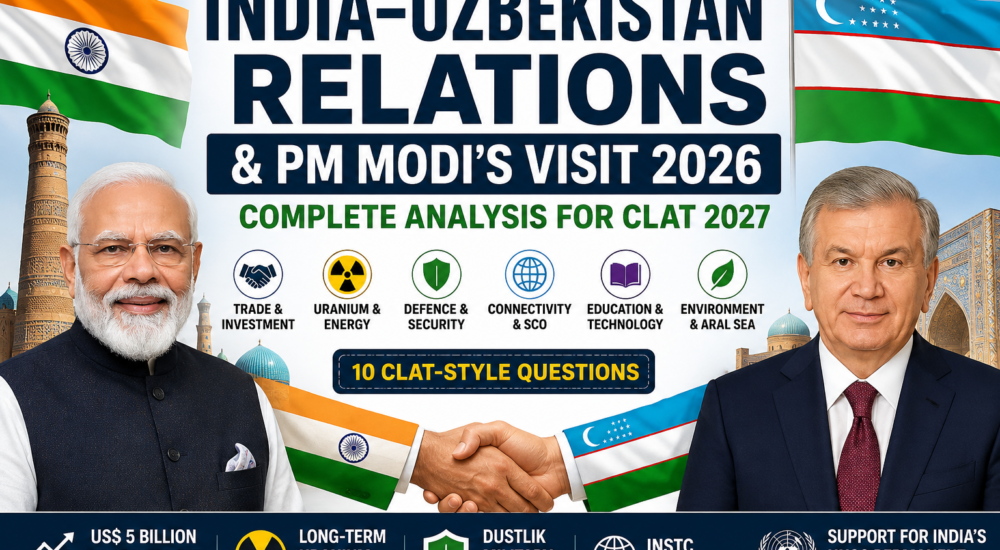
India–Uzbekistan Relations & PM Modi’s Visit 2026: Complete Analysis for CLAT 2027
India–Uzbekistan relations have gained fresh strategic importance following Prime Minister Narendra Modi’s State Visit to Uzbekistan on 29–30 August 2026. The visit focused on strengthening bilateral ties in areas such as trade, energy, critical minerals, defence, counter-terrorism, connectivity, technology, healthcare and education.
For CLAT 2027 aspirants, this is an important Current Affairs topic because it combines International Relations, Indian Foreign Policy, Central Asian Geography, Economy, Nuclear Energy, Defence, International Organisations and Constitutional provisions.
In this article, we will cover the topic from a CLAT examination perspective and conclude with 10 CLAT-style questions.
India–Uzbekistan Relations: Why Is This Topic Important?
Uzbekistan is one of the most strategically important countries in Central Asia. Its geographical location, natural resources and proximity to Afghanistan make it significant for India’s economic and security interests.
India is also trying to strengthen its presence in Central Asia through greater cooperation in:
- Trade and investment
- Energy security
- Critical minerals
- Defence
- Counter-terrorism
- Connectivity
- Digital technology
- Pharmaceuticals
- Education
- Space cooperation
The 2026 visit therefore represents more than a routine diplomatic engagement. It reflects India’s broader strategy of building stronger partnerships with Central Asian countries.
Uzbekistan: Basic Facts
Uzbekistan is a landlocked country in Central Asia.
Important Facts
| Particular | Details |
| Country | Uzbekistan |
| Region | Central Asia |
| Capital | Tashkent |
| Currency | Uzbekistani Som |
| President | Shavkat Mirziyoyev |
| Official Language | Uzbek |
| Independence | 1991 |
| Major City | Tashkent |
| Status | Landlocked country |
Uzbekistan shares borders with Kazakhstan, Kyrgyzstan, Tajikistan, Afghanistan and Turkmenistan.
CLAT Fact: Doubly Landlocked Country
Uzbekistan is one of only two doubly landlocked countries in the world. The other is Liechtenstein.
A doubly landlocked country is a country surrounded only by countries that themselves have no coastline.
Historical Connection Between India and Uzbekistan
India and Central Asia have maintained connections for centuries through trade, culture and the historic Silk Road.
One of the most famous historical connections between India and present-day Uzbekistan is Zahir-ud-din Muhammad Babur.
Babur was born in Andijan, in present-day Uzbekistan. He later established the Mughal Empire in India after defeating Ibrahim Lodi in the First Battle of Panipat in 1526.
This historical connection continues to contribute to cultural links between India and Uzbekistan.
Establishment of Diplomatic Relations
India established diplomatic relations with Uzbekistan in 1992, following Uzbekistan’s independence from the Soviet Union.
Since then, bilateral relations have gradually expanded from traditional diplomatic engagement to multiple areas, including:
- Defence
- Trade
- Pharmaceuticals
- Information technology
- Agriculture
- Education
- Healthcare
- Energy
- Counter-terrorism
- Culture
PM Modi’s Uzbekistan Visit 2026
Prime Minister Narendra Modi visited Uzbekistan on 29–30 August 2026 at the invitation of Uzbek President Shavkat Mirziyoyev.
The two leaders discussed bilateral, regional and international issues.
One of the most important outcomes was the decision to elevate India–Uzbekistan relations to a:
Comprehensive Strategic Partnership
This demonstrates the increasing importance attached by both countries to their long-term strategic relationship.
Uzbekistan’s Highest Honour for PM Modi
During the visit, President Shavkat Mirziyoyev conferred Uzbekistan’s highest honour for foreign leaders on Prime Minister Narendra Modi.
The honour is known as:
Oliy Darajali Do’stlik Order
It broadly translates to the Order of Highest Friendship.
The award recognises PM Modi’s contribution to strengthening friendship and cooperation between India and Uzbekistan.
CLAT Quick Fact
Oliy Darajali Do’stlik → Uzbekistan → Highest honour for foreign leaders
$5 Billion Bilateral Trade Target
India and Uzbekistan have set an ambitious target of increasing bilateral trade to:
US$5 Billion Annually by 2030
The two countries intend to expand cooperation in sectors such as:
- Pharmaceuticals
- Engineering goods
- Automobiles
- Electrical products
- Manufacturing
- Investment
- E-commerce
They also discussed reducing non-tariff barriers and improving market access.
Why is this important?
Increasing bilateral trade can:
Improve market access → Increase investment → Strengthen supply chains → Promote economic growth
Preferential Trade Agreement
India and Uzbekistan have completed a Joint Feasibility Study for a Preferential Trade Agreement (PTA).
The two sides are considering the next steps towards expanding preferential trade.
What is a PTA?
A Preferential Trade Agreement provides preferential tariff treatment to selected goods traded between participating countries.
PTA vs FTA
PTA: Preferential treatment for selected products.
FTA: Generally involves much broader tariff liberalisation between participating countries.
This distinction is important for CLAT because questions can test both current affairs and basic economic concepts.
Uranium Supply: A Major Strategic Development
One of the most important outcomes of the visit was the decision to establish a:
Long-Term Arrangement for Uranium Supplies from Uzbekistan to India
Uranium is an important fuel for nuclear power generation.
For India, long-term uranium supplies are relevant to:
- Energy security
- Nuclear power expansion
- Diversification of fuel sources
- Reduction of supply-chain risks
India is seeking to expand nuclear energy as part of its long-term energy strategy.
Therefore, uranium cooperation has significance beyond ordinary commercial trade.
Critical and Strategic Minerals
India and Uzbekistan also identified opportunities for cooperation in critical and strategic minerals.
Areas of cooperation include:
- Geological exploration
- Mining
- Mineral processing
- Recycling
- Value addition
- Integrated supply chains
Why are critical minerals important?
Modern industries depend heavily on critical minerals.
They are important for:
- Electric vehicles
- Batteries
- Renewable energy
- Electronics
- Semiconductors
- Defence equipment
- Aerospace
- Telecommunications
Thus, critical minerals are increasingly connected with both economic security and national security.
Defence Cooperation
Defence cooperation is another important pillar of India–Uzbekistan relations.
The two countries cooperate through institutional mechanisms such as the Joint Working Group on Military Cooperation.
They are also exploring opportunities for greater cooperation in the defence industry.
Exercise DUSTLIK
India and Uzbekistan conduct a joint military exercise known as:
DUSTLIK
The exercise focuses on strengthening military cooperation, interoperability and the ability of the armed forces to operate together.
Counter-Terrorism Cooperation
India and Uzbekistan share concerns regarding:
- Terrorism
- Violent extremism
- Terror financing
- Drug trafficking
- Organised crime
- Cybersecurity threats
The two countries cooperate through the Joint Working Group on Counter-Terrorism.
The issue is particularly important because Central Asia is geographically close to Afghanistan, making regional security and terrorism major concerns.
Afghanistan and Central Asian Security
Afghanistan is located immediately south of Uzbekistan.
Instability in Afghanistan can have wider implications for:
- Central Asian security
- Terrorism
- Drug trafficking
- Extremism
- Regional connectivity
For India, engagement with Uzbekistan therefore also provides an opportunity to discuss broader regional security concerns.
Connectivity: Why Is It Important?
India and Uzbekistan do not share a land border.
This creates a major challenge for direct overland trade.
Efficient connectivity is therefore essential for India’s engagement with Central Asia.
One important initiative is the:
International North-South Transport Corridor — INSTC
The INSTC is a multimodal transportation network designed to improve connectivity between India, Iran, Central Asia, Russia and Europe.
Improved connectivity can:
- Reduce transportation costs
- Reduce travel time for goods
- Improve trade
- Strengthen supply chains
- Increase India’s access to Central Asian markets
India and Uzbekistan: Digital Technology & AI
Technology is emerging as a major area of cooperation.
India and Uzbekistan have discussed cooperation in:
- Information technology
- Artificial intelligence
- Digital transformation
- Startups
- Technology parks
- Cybersecurity
The IT Park in Tashkent has an important connection with India and was developed with Indian support and experience.
The two countries also seek cooperation in developing safe, secure and trustworthy AI.
Space Cooperation
India and Uzbekistan are also expanding cooperation in the peaceful uses of outer space.
Potential areas include:
- Space applications
- Scientific data
- Training
- Workshops
- Research
- Capacity building
India’s growing space capabilities provide opportunities for cooperation with developing countries in areas such as remote sensing, disaster management and satellite applications.
Pharmaceutical and Healthcare Cooperation
India is one of the world’s major pharmaceutical producers.
Indian pharmaceutical companies have an important presence in international markets, including Central Asia.
India and Uzbekistan are strengthening cooperation in:
- Pharmaceutical manufacturing
- Medical research
- Biomedical sciences
- Laboratories
- Medical centres
- Healthcare technology
The Tashkent Pharma Park is expected to provide opportunities for pharmaceutical manufacturing, investment and joint projects.
Education and Skill Development
Education is another important pillar of bilateral relations.
Cooperation includes:
- Student exchanges
- Scholarships
- Academic partnerships
- Research
- Professional training
- Skill development
Uzbek nationals have also participated in India’s ITEC programme, which provides training and capacity-building opportunities to participants from developing countries.
Environment and the Aral Sea
The Aral Sea is one of the world’s most important environmental case studies.
Once one of the world’s largest inland water bodies, the Aral Sea has suffered severe ecological degradation.
India and Uzbekistan have agreed to cooperate in the:
Greening and Ecological Rehabilitation of the Aral Sea Region
India will provide financial and technical support for ecological rehabilitation.
India’s Permanent Membership of the UN Security Council
Another major diplomatic aspect is Uzbekistan’s support for India’s candidature for permanent membership of the UN Security Council.
India has long argued that the structure of the Security Council should reflect contemporary global realities.
Current Permanent Members — P5
The five permanent members are:
- United States
- United Kingdom
- France
- Russia
- China
India is currently not a permanent member of the Security Council.
India supports comprehensive reform of the United Nations, including reform of the Security Council.
India, Uzbekistan and the SCO
Both India and Uzbekistan are members of the:
Shanghai Cooperation Organisation — SCO
The SCO is a major Eurasian organisation concerned with:
- Regional security
- Counter-terrorism
- Economic cooperation
- Connectivity
- Cultural cooperation
India became a full member of the SCO in 2017.
Uzbekistan is also an important Central Asian member of the organisation.
The SCO provides another platform through which India and Uzbekistan can cooperate on regional issues.
International Solar Alliance
The International Solar Alliance (ISA) is an India-led international initiative aimed at promoting solar energy cooperation.
India and Uzbekistan have discussed cooperation with international initiatives including the ISA.
This is significant because renewable energy is increasingly linked with:
- Energy security
- Climate change
- Sustainable development
- Clean technology
International Big Cat Alliance
The International Big Cat Alliance (IBCA) is an India-led initiative focused on the conservation of big cats and their habitats.
Uzbekistan has expressed interest in joining international initiatives promoted by India, including the IBCA.
This illustrates that India–Uzbekistan cooperation is not restricted to trade and security but also extends to environmental conservation.
Uzbekistan and the Non-Aligned Movement
Uzbekistan is set to chair the Non-Aligned Movement (NAM) from 2027 to 2030.
India is one of the founding members of NAM.
This gives India and Uzbekistan another platform for cooperation on issues involving developing countries and the Global South.
Constitutional Angle: Article 51
India’s foreign policy can also be connected with Article 51 of the Constitution of India.
Article 51 is part of the:
Directive Principles of State Policy
It directs the State to promote:
- International peace and security
- Just and honourable relations between nations
- Respect for international law and treaty obligations
- Settlement of international disputes by arbitration
Important CLAT Point
Article 51 is a Directive Principle of State Policy, not a Fundamental Right.
Directive Principles are not directly enforceable by courts.
Why Is Uzbekistan Strategically Important for India?
India’s interest in Uzbekistan can be remembered using six key areas:
1. Energy
Uranium and energy security.
2. Economy
Trade and investment.
3. Connectivity
Access to Central Asian markets.
4. Security
Counter-terrorism and regional stability.
5. Critical Minerals
Mineral resources and strategic supply chains.
6. Technology
IT, AI, space and digital cooperation.
Why Is India Important for Uzbekistan?
India provides Uzbekistan with opportunities in:
- Pharmaceuticals
- Healthcare
- IT
- AI
- Education
- Defence
- Investment
- Manufacturing
- Digital technology
- Agricultural and technical expertise
The relationship is therefore increasingly based on mutual strategic and economic interests.
Quick Revision: Important Facts
| Topic | Key Fact |
| PM Modi’s Visit | 29–30 August 2026 |
| Uzbek President | Shavkat Mirziyoyev |
| Capital | Tashkent |
| Major Outcome | Comprehensive Strategic Partnership |
| Trade Target | US$5 billion by 2030 |
| Major Energy Development | Long-term uranium supply |
| Highest Uzbek Honour | Oliy Darajali Do’stlik |
| Military Exercise | DUSTLIK |
| Regional Organisation | SCO |
| Connectivity | INSTC |
| Environmental Issue | Aral Sea |
| UNSC | Uzbekistan supports India’s permanent membership |
| NAM | Uzbekistan to chair 2027–2030 |
| Constitutional Connection | Article 51 |
| Historical Figure | Babur |
CLAT-Style Questions
Question 1
India and Uzbekistan agreed during PM Modi’s 2026 visit to elevate their bilateral relationship to:
- Strategic Defence Partnership
B. Comprehensive Strategic Partnership
C. Comprehensive Economic Partnership
D. Special Economic Partnership
Answer: B
Question 2
Who is the President of Uzbekistan?
- Kassym-Jomart Tokayev
B. Emomali Rahmon
C. Shavkat Mirziyoyev
D. Sadyr Japarov
Answer: C
Question 3
What bilateral trade target has India and Uzbekistan set for 2030?
- US$2 billion
B. US$3 billion
C. US$5 billion
D. US$10 billion
Answer: C
Question 4
The long-term uranium supply arrangement between India and Uzbekistan is primarily connected with which of the following?
- Food security
B. Energy security
C. Maritime security
D. Cyber security
Answer: B
Question 5
DUSTLIK is associated with:
- India–Uzbekistan military cooperation
B. India–Uzbekistan space cooperation
C. India–Uzbekistan trade negotiations
D. India–Uzbekistan environmental cooperation
Answer: A
Question 6
Which of the following countries does NOT share a land boundary with Uzbekistan?
- Afghanistan
B. Kazakhstan
C. Tajikistan
D. India
Answer: D
Question 7
Consider the following statements:
- Uzbekistan is a landlocked country.
- Uzbekistan is one of the world’s doubly landlocked countries.
- Uzbekistan shares a land border with India.
Which of the above statements is/are correct?
- 1 only
B. 1 and 2 only
C. 2 and 3 only
D. 1, 2 and 3
Answer: B
Question 8
Article 51 of the Indian Constitution is primarily concerned with:
- Fundamental Rights
B. Fundamental Duties
C. Directive Principles of State Policy
D. Emergency Provisions
Answer: C
Question 9
Which of the following best explains the strategic importance of Uzbekistan for India?
- Uzbekistan provides India with direct access to the Mediterranean Sea.
- Uzbekistan is important because of its Central Asian location, energy resources, critical minerals, connectivity potential and regional security relevance.
- Uzbekistan is India’s only Central Asian neighbour.
- Uzbekistan is a member of NATO and the European Union.
Answer: B
Question 10
Which of the following pairs is correctly matched?
- DUSTLIK — India–Uzbekistan military exercise
B. INSTC — India–Uzbekistan defence exercise
C. SCO — International nuclear regulator
D. Oliy Darajali Do’stlik — India’s highest civilian award
Answer: A