


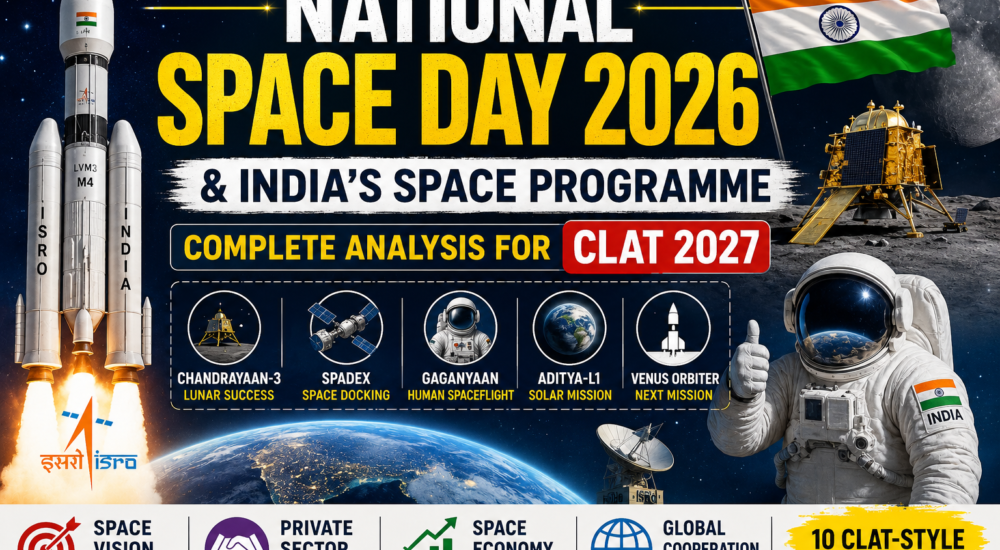
National Space Day 2026 & India’s Space Programme: Complete Analysis for CLAT 2027
National Space Day is an important current-affairs topic for CLAT 2027 because India’s space programme is no longer limited to satellite launches and scientific exploration. It now covers national security, communication, agriculture, disaster management, climate studies, navigation, private space companies, international cooperation, human spaceflight and the future space economy.
India celebrates National Space Day on 23 August every year to commemorate the historic soft landing of Chandrayaan-3’s Vikram lander near the lunar south polar region on 23 August 2023. India became the fourth country to achieve a soft landing on the Moon and the first to reach the lunar south-polar region.
In 2026, India celebrated its 3rd National Space Day on 23 August 2026 in Ahmedabad.
The theme for National Space Day 2026 was:
“Towards Viksit Bharat: Innovating, Collaborating and Aspiring to Global Space Leadership”
The theme highlights three major ideas:
Innovation + Collaboration + Global Leadership
What Is National Space Day?
National Space Day is observed in India every year on:
23 August
The day commemorates the successful landing of Chandrayaan-3’s Vikram lander on the Moon on 23 August 2023.
The landing was significant because India became:
- The fourth country to successfully soft-land on the Moon.
- The first country to land near the lunar south-polar region.
The landing site was named:
Shiv Shakti Point
The rover deployed by Chandrayaan-3 was named:
Pragyan
Following the achievement, Prime Minister Narendra Modi declared 23 August as National Space Day.
CLAT Quick Fact
23 August → National Space Day → Chandrayaan-3 → Vikram → Pragyan → Shiv Shakti Point
National Space Day 2026
India celebrated its third National Space Day on 23 August 2026.
The main event was held in Ahmedabad, Gujarat, considering the importance of the city’s space ecosystem and the presence of the Space Applications Centre (SAC).
Theme of National Space Day 2026
“Towards Viksit Bharat: Innovating, Collaborating and Aspiring to Global Space Leadership”
The theme reflects India’s ambition to use space technology not merely for scientific achievement but also for:
- Economic development
- Innovation
- Public welfare
- Industrial growth
- National security
- Global cooperation
- Human development
ISRO Chairman Dr. V. Narayanan highlighted that India’s space journey has evolved from launching small sounding rockets in the 1960s to undertaking sophisticated missions and supporting commercial satellite launches.
Why Is National Space Day Important for CLAT?
At first glance, space may appear to be a pure Science & Technology topic.
However, for CLAT, India’s space programme can be connected with several subjects.
Science & Technology
- Satellites
- Rockets
- Lunar missions
- Solar missions
- Human spaceflight
- Space docking
Economy
- Space economy
- Private space companies
- Commercial launches
- Startups
- Technology transfer
Defence
- Satellite surveillance
- Communication
- Navigation
- Space security
- Situational awareness
Environment
- Earth observation
- Climate monitoring
- Disaster management
- Environmental mapping
International Relations
- India-NASA cooperation
- International Space Station
- International space partnerships
- Commercial space missions
Government Policy
- Space reforms 2020
- Indian Space Policy 2023
- IN-SPACe
- NSIL
- Space Vision 2047
India’s Space Programme: How Did It Begin?
India’s space programme began with a strong focus on using space technology for national development.
One of the most important figures in India’s early space programme was:
Dr. Vikram Sarabhai
He is widely regarded as the father of the Indian space programme.
India’s early space efforts focused heavily on practical applications of space technology.
The philosophy was simple:
Space technology should ultimately improve the lives of ordinary people.
Applications included:
- Communication
- Weather forecasting
- Remote sensing
- Education
- Agriculture
- Disaster management
This development-oriented approach remains an important characteristic of India’s space programme.
Formation of ISRO
The:
Indian Space Research Organisation — ISRO
is India’s primary space agency.
ISRO operates under the:
Department of Space — DoS
The Department of Space is under the direct charge of the Prime Minister of India.
ISRO’s work covers:
- Space science
- Launch vehicles
- Satellites
- Earth observation
- Navigation
- Communication
- Planetary exploration
- Human spaceflight
- Space applications
India’s Major Launch Vehicles
India has developed a range of launch vehicles.
PSLV
Polar Satellite Launch Vehicle
PSLV has become one of India’s most reliable launch vehicles.
It has been widely used for:
- Earth observation satellites
- Scientific missions
- Navigation satellites
- Commercial satellite launches
GSLV
Geosynchronous Satellite Launch Vehicle
GSLV is designed to launch heavier payloads into geosynchronous transfer orbit.
LVM3
The:
Launch Vehicle Mark-3 — LVM3
is one of India’s most powerful operational launch vehicles.
It is particularly important for:
- Heavy satellite launches
- Chandrayaan missions
- Gaganyaan programme
Chandrayaan Programme
India’s lunar exploration programme is known as:
Chandrayaan
Chandrayaan-1
Launched in 2008, Chandrayaan-1 was India’s first lunar mission.
One of its major scientific contributions was the detection of evidence related to water molecules/water-ice on the Moon.
Chandrayaan-2
Launched in 2019, Chandrayaan-2 consisted of:
- Orbiter
- Vikram lander
- Pragyan rover
The lander could not achieve a successful soft landing, but the orbiter continued to provide valuable scientific data.
Chandrayaan-3
Chandrayaan-3 was designed to demonstrate:
- Safe landing
- Rover movement
- Scientific experiments on the lunar surface
It successfully landed on 23 August 2023.
This achievement became the basis for India’s National Space Day.
Why Is the Lunar South Pole Important?
The lunar south-polar region is scientifically important because some permanently shadowed areas may contain water ice.
Water resources on the Moon could potentially be important for future exploration.
Water could potentially be used for:
- Scientific research
- Life-support systems
- Production of hydrogen and oxygen
- Future lunar missions
Therefore, the Chandrayaan-3 landing was not merely a symbolic achievement.
It also contributed to India’s scientific understanding of the Moon.
Aditya-L1: India’s Solar Mission
India’s first dedicated space-based solar observatory is:
Aditya-L1
It studies the Sun and its atmosphere.
The mission focuses particularly on the:
- Photosphere
- Chromosphere
- Corona
- Solar activity
Aditya-L1 is positioned around the:
L1 Lagrange Point
What is a Lagrange Point?
Lagrange points are positions in space where the gravitational effects of two large bodies can create relatively stable locations for spacecraft.
The L1 point between the Earth and Sun is particularly useful for observing the Sun continuously.
XPoSat: Studying X-Ray Polarisation
India’s:
XPoSat — X-ray Polarimeter Satellite
is designed to study the polarisation of X-rays from astronomical sources.
It helps scientists study extreme cosmic objects and high-energy astrophysical phenomena.
This demonstrates that India’s space programme is increasingly moving from:
Earth observation → Planetary exploration → Advanced space science
SpaDeX: A Major Recent Development
One of the most important recent technological achievements is:
SpaDeX — Space Docking Experiment
The mission demonstrated the technology required for two spacecraft to:
- Rendezvous
- Approach each other
- Dock
- Undock
- Operate after docking
ISRO successfully docked the two SpaDeX satellites in January 2025. It subsequently demonstrated undocking and later a second autonomous docking with power transfer between the satellites.
India thereby demonstrated an important capability needed for future complex missions.
Why Is Docking Important?
Docking technology is important for:
- Space stations
- Human spaceflight
- In-orbit servicing
- Spacecraft assembly
- Sample-return missions
- Future lunar missions
ISRO has specifically linked docking technology to future ambitions such as the Bharatiya Antariksh Station and lunar sample-return missions.
CLAT Fact
India became the fourth nation to demonstrate space docking technology through SpaDeX.
Gaganyaan Mission
One of India’s most ambitious space programmes is:
Gaganyaan
Gaganyaan aims to demonstrate India’s capability to send Indian astronauts into Low Earth Orbit and safely return them to Earth.
The programme is significant because human spaceflight requires technologies far more complex than conventional satellite launches.
These include:
- Human-rated launch vehicle
- Crew module
- Life-support systems
- Crew escape systems
- Astronaut training
- Recovery systems
- Mission control
Shubhanshu Shukla and the International Space Station
India’s human-spaceflight programme received a major boost through Group Captain Shubhanshu Shukla’s participation in the Axiom-4 mission to the International Space Station in 2025.
According to ISRO’s space situational awareness report, Shukla became the first Indian astronaut to board the ISS and conducted microgravity experiments during the mission.
This experience is important for India because it contributes to knowledge in:
- Human spaceflight
- Astronaut operations
- Microgravity research
- Crew coordination
- Emergency procedures
Bharatiya Antariksh Station
India’s long-term space vision includes the development of:
Bharatiya Antariksh Station — BAS
The Government’s Space Vision 2047 targets establishing the Bharatiya Antariksh Station by 2035.
The first module is planned as part of the country’s long-term human-spaceflight programme.
The space station would provide India with a platform for:
- Microgravity experiments
- Space science
- Technology demonstrations
- Human spaceflight research
- International cooperation
The development of docking technology through SpaDeX is therefore directly relevant to this ambition.
Chandrayaan-4
India’s next major lunar ambition includes:
Chandrayaan-4
The mission is designed to develop and demonstrate technologies needed to:
- Land on the Moon
- Collect lunar samples
- Take samples off the lunar surface
- Return them safely to Earth
This is significantly more complex than simply landing a spacecraft.
The mission forms part of India’s longer-term lunar exploration roadmap.
Venus Orbiter Mission
India is also preparing for its first mission to Venus:
Venus Orbiter Mission — VOM
The mission is planned to study Venus’s:
- Surface
- Subsurface
- Atmosphere
- Ionosphere
- Geological processes
The mission is currently targeted for launch in March 2028.
Space Vision 2047
India’s long-term vision is not restricted to individual missions.
The Government has articulated:
Space Vision 2047
Major objectives include:
By 2035
Establishment of the:
Bharatiya Antariksh Station
By 2040
An Indian astronaut is targeted to land on the:
Moon
Other components include:
- Gaganyaan follow-on missions
- Chandrayaan-4
- Venus Orbiter Mission
- Next Generation Launch Vehicle
- Expansion of the private space ecosystem
Next Generation Launch Vehicle — NGLV
India is also working toward a:
Next Generation Launch Vehicle — NGLV
The objective is to develop a more capable and cost-effective launch system.
It is expected to support future missions involving:
- Heavy payloads
- Human spaceflight
- Space infrastructure
- Commercial launches
- Deep-space exploration
The NGLV is part of India’s long-term space roadmap.
Private Space Sector in India
One of the biggest changes in India’s space programme has been the opening of the sector to private companies.
In 2020, the Government introduced major space-sector reforms aimed at encouraging private-sector participation across the space value chain.
These reforms created opportunities for private companies to participate in:
- Satellite manufacturing
- Launch vehicles
- Space applications
- Ground systems
- Space services
- Research and development
IN-SPACe
Indian National Space Promotion and Authorisation Centre — IN-SPACe
was created as an autonomous, single-window agency to:
- Authorise space activities
- Promote private participation
- Facilitate access to infrastructure
- Encourage innovation
- Support non-government entities
This is an important institution for understanding India’s new space ecosystem.
CLAT Trap
IN-SPACe is not the same as ISRO.
ISRO is India’s space research organisation.
IN-SPACe is primarily concerned with promotion and authorisation of space activities and facilitating private participation.
NSIL
Another important organisation is:
NewSpace India Limited — NSIL
NSIL is a public-sector enterprise under the Department of Space.
Its role includes:
- Commercialisation of space technologies
- Commercial launch services
- Technology transfer
- Industry participation
- Commercial utilisation of India’s space capabilities
The 2020 reforms envisioned NSIL as an important component in shifting space activities from a supply-driven model toward a more demand-driven and commercial approach.
Indian Space Policy 2023
The:
Indian Space Policy 2023
provides the broader policy framework for India’s space sector.
Its vision includes:
- Expanding India’s space capabilities
- Encouraging commercial space activities
- Promoting private participation
- Using space technology for socio-economic development
- Supporting peaceful exploration
- Promoting international cooperation
The policy encourages greater private-sector participation across the entire space value chain.
ISRO, IN-SPACe, NSIL and Department of Space: Difference
This is a very useful CLAT concept.
| Organisation | Main Role |
| ISRO | Research, technology development and space missions |
| IN-SPACe | Promotion and authorisation of space activities |
| NSIL | Commercialisation of space technologies and services |
| Department of Space | Overall governmental framework and policy |
Easy Way to Remember
ISRO → Research
IN-SPACe → Regulate/Promote
NSIL → Commercialise
DoS → Governmental oversight
Rise of Space Startups
India’s space reforms have encouraged a growing startup ecosystem.
According to ISRO, by National Space Day 2026 the country had more than 440 space startups.
These companies are working in areas such as:
- Launch vehicles
- Satellites
- Earth observation
- Space data
- Propulsion
- Communication
- Space manufacturing
This is transforming India’s space sector from a primarily government-driven ecosystem into a more diverse public-private space economy.
Skyroot Aerospace and Private Launch Capability
The rise of Indian private launch companies is another important development.
At the 2026 National Space Day event, ISRO highlighted the successful orbital flight of Vikram-1 by Skyroot Aerospace, describing it as the company’s first orbital flight and congratulating the team.
This represents the growing role of private companies in India’s launch ecosystem.
Space Technology and Everyday Life
India’s space programme is not limited to astronauts and rockets.
Space technology directly affects everyday life.
Agriculture
Satellite imagery can help with:
- Crop monitoring
- Weather information
- Drought assessment
- Soil and land-use analysis
Disaster Management
Satellites help monitor:
- Floods
- Cyclones
- Landslides
- Forest fires
- Droughts
Communication
Satellites support:
- Television
- Telecommunications
- Internet connectivity
- Remote communication
Navigation
India’s regional navigation system:
NavIC
provides positioning, navigation and timing services.
Space and National Security
Space has become an important component of national security.
Satellites can provide:
- Secure communication
- Navigation
- Intelligence
- Surveillance
- Border monitoring
- Disaster response
Therefore, space is increasingly viewed as a strategic domain.
However, India also emphasises the peaceful uses of outer space and international cooperation.
Space Debris
One of the major challenges facing the modern space sector is:
Space Debris
Space debris includes:
- Defunct satellites
- Rocket stages
- Fragments from collisions
- Other human-made objects in orbit
The increasing number of objects in orbit creates risks for operational spacecraft.
ISRO’s Indian Space Situational Awareness Report 2025 highlighted the importance of monitoring orbital debris and noted that SpaDeX-related demonstrations could contribute to future capabilities such as in-space servicing and active debris removal.
International Cooperation in Space
India’s space programme increasingly involves international partnerships.
Examples include cooperation with:
- NASA
- European Space Agency
- Other national space agencies
- International organisations
- Private international companies
One major example is:
NISAR
The:
NASA-ISRO Synthetic Aperture Radar — NISAR
is a joint Earth-observation mission of NASA and ISRO.
Such partnerships demonstrate that space exploration is increasingly based on international scientific collaboration.
Space Economy
The global space sector is evolving into a major economic ecosystem.
India’s space economy includes:
- Satellite manufacturing
- Launch services
- Communication
- Earth observation
- Navigation
- Space data
- Ground infrastructure
- Space tourism
- Research
- Commercial applications
India’s reforms aim to increase the country’s role in the global space economy by encouraging private investment and innovation.
Why Is Space Important for Viksit Bharat?
India’s space programme supports the broader goal of:
Viksit Bharat
Space technology can contribute to:
- Digital connectivity
- Rural development
- Agriculture
- Healthcare
- Disaster management
- Infrastructure planning
- National security
- Scientific research
- Industrial development
Therefore, the space sector is increasingly seen as an enabler of national development.
Legal and Policy Angle for CLAT
The space sector provides several important legal and policy concepts.
- Indian Space Policy 2023
Provides the broad policy framework.
- Space-sector reforms 2020
Opened greater opportunities for private-sector participation.
- IN-SPACe
Promotes and authorises space activities.
- International Space Law
India’s space activities operate within the broader framework of international space law.
Important international instruments include:
- Outer Space Treaty, 1967
- Rescue Agreement, 1968
- Liability Convention, 1972
- Registration Convention, 1975
- Moon Agreement, 1979
CLAT Tip
Students should distinguish between:
Domestic space policy and international space law.
India’s Space Programme: Major Missions at a Glance
| Mission/Programme | Main Purpose |
| Aryabhata | India’s first satellite |
| Chandrayaan-1 | Lunar exploration |
| Chandrayaan-2 | Lunar orbiter, lander and rover |
| Chandrayaan-3 | Soft landing and rover demonstration |
| Mangalyaan | Mars exploration |
| Aditya-L1 | Solar observation |
| XPoSat | X-ray polarisation studies |
| SpaDeX | Space docking technology |
| Gaganyaan | Human spaceflight |
| Chandrayaan-4 | Lunar sample-return technology |
| Venus Orbiter Mission | Venus exploration |
| NISAR | Earth observation |
| Bharatiya Antariksh Station | Future space station |
Important Current Affairs for CLAT 2027
For CLAT 2027, students should especially remember these recent developments:
National Space Day 2026
23 August 2026
Theme
Towards Viksit Bharat: Innovating, Collaborating and Aspiring to Global Space Leadership
SpaDeX
India successfully demonstrated docking, undocking and power-transfer capabilities.
Shubhanshu Shukla
First Indian astronaut to visit the International Space Station.
Bharatiya Antariksh Station
Targeted for establishment by 2035.
Indian Astronaut on Moon
Targeted for 2040 under Space Vision 2047.
Chandrayaan-4
Planned lunar sample-return technology mission.
Venus Orbiter Mission
Targeted for launch in 2028.
Space Startups
India’s space startup ecosystem has crossed 440 startups, according to ISRO’s 2026 National Space Day update.
CLAT Quick Revision Table
| Topic | Key Fact |
| National Space Day | 23 August |
| Reason | Chandrayaan-3 soft landing |
| Chandrayaan-3 Landing | 23 August 2023 |
| Landing Site | Shiv Shakti Point |
| Lander | Vikram |
| Rover | Pragyan |
| 2026 National Space Day | 3rd edition |
| 2026 Venue | Ahmedabad |
| 2026 Theme | Towards Viksit Bharat… |
| Space Agency | ISRO |
| Solar Mission | Aditya-L1 |
| Lunar Programme | Chandrayaan |
| Mars Mission | Mangalyaan |
| Space Docking | SpaDeX |
| Human Spaceflight | Gaganyaan |
| Future Space Station | Bharatiya Antariksh Station |
| Future Lunar Mission | Chandrayaan-4 |
| Venus Mission | Venus Orbiter Mission |
| Space Policy | Indian Space Policy 2023 |
| Private Sector Facilitator | IN-SPACe |
| Commercialisation | NSIL |
| Long-term Vision | Space Vision 2047 |
| Space Station Target | 2035 |
| Indian Moon Landing Target | 2040 |
CLAT-Style Questions
Question 1
National Space Day is observed in India on:
- 15 August
B. 23 August
C. 26 January
D. 28 February
Answer: B. 23 August
Question 2
Why is 23 August observed as National Space Day?
- Launch of India’s first satellite
- Successful launch of Chandrayaan-1
- Successful soft landing of Chandrayaan-3 on the Moon
- Launch of India’s first rocket
Answer: C. Successful soft landing of Chandrayaan-3
Question 3
Consider the following statements:
- India became the fourth country to achieve a soft landing on the Moon.
- Chandrayaan-3 landed near the lunar south-polar region.
- The rover deployed by Chandrayaan-3 was named Vikram.
Which of the above statements is/are correct?
- 1 only
B. 1 and 2 only
C. 2 and 3 only
D. 1, 2 and 3
Answer: B
Explanation: Vikram was the lander, while Pragyan was the rover.
Question 4
The SpaDeX mission is primarily associated with:
- Solar observation
- Space docking technology
- Mars exploration
- Venus exploration
Answer: B. Space docking technology
Question 5
Which of the following is correctly matched?
- Aditya-L1 — Venus exploration
- Chandrayaan-3 — Solar observation
- SpaDeX — Space docking
- Gaganyaan — Lunar rover
Answer: C. SpaDeX — Space docking
Question 6
Which organisation is primarily responsible for promoting and authorising space activities by government and non-government entities in India’s space sector?
- ISRO
- IN-SPACe
- NASA
- NSIL
Answer: B. IN-SPACe
Question 7
Consider the following pairs:
- Aditya-L1 — Sun
- Chandrayaan — Moon
- Venus Orbiter Mission — Venus
- Mangalyaan — Mars
Which of the above pairs are correctly matched?
- 1 and 2 only
- 1, 2 and 3 only
- 2, 3 and 4 only
- 1, 2, 3 and 4
Answer: D
Question 8
Under India’s Space Vision 2047, the Bharatiya Antariksh Station is targeted for establishment by:
- 2028
- 2030
- 2035
- 2047
Answer: C. 2035
Question 9
Which of the following best describes the significance of India’s 2020 space-sector reforms?
- They prohibited private companies from participating in space activities.
- They opened greater opportunities for private-sector participation across the space value chain.
- They transferred ISRO to the Ministry of Defence.
- They ended India’s participation in international space missions.
Answer: B
Question 10
Consider the following statements:
- National Space Day commemorates Chandrayaan-3’s successful landing.
- SpaDeX demonstrated space docking technology.
- Gaganyaan is India’s human-spaceflight programme.
- IN-SPACe is responsible for conducting all ISRO scientific missions.
Which statement is incorrect?
- 1
- 2
- 3
- 4
Answer: D
Explanation: IN-SPACe is responsible for promoting and authorising space activities and facilitating private participation. It does not conduct all ISRO scientific missions.